

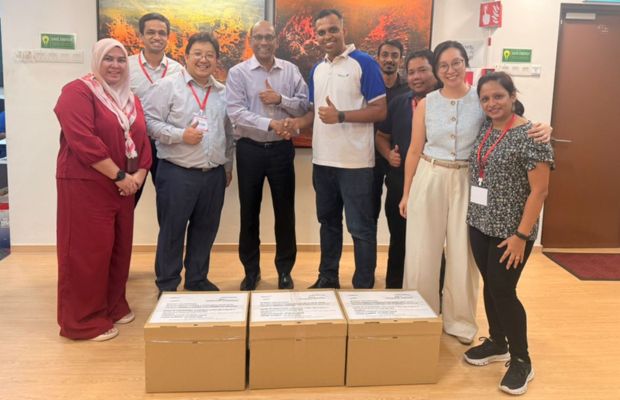
Blueleaf Energy, a pan-Asian renewable energy platform and an independent power producer (IPP), secured an order from Malaysia’s Energy Commission (Suruhanjaya Tenaga). The company said in a press release that it secured the order to build, own, and operate a 100 MW/400 MWh utility-scale Battery Energy Storage System (BESS), to be developed in partnership with Universal Peak Sdn. Bhd in Malaysia.
The company explained that the project is part of the Malaysia Battery Energy Storage System (MyBeST) programme, which offers a competitive bidding initiative. This also represents one of the largest grid-connected BESS in Peninsular Malaysia to date. With a targeted commissioning date in 2027, the project is expected to strengthen Malaysia’s national grid and accelerate the country’s transition to a carbon-neutral renewable energy future.
Bluefeaf has been expanding its presence in the asian market. For instance, the company last year, in 2025, partnered with British International Investment (BII), the UK’s development finance institution (DFI) and impact investor. The company collaborated with BII to secure a $75 million USD financing facility investment to finance the company’s investment expansion in renewable energy assets across India.
The investment was made to contribute towards nearly 2GW of installed clean energy capacity to the nation. It will include utility-scale solar, wind and energy storage projects that could generate annually over 3.2GWh of clean energy.
Later in 2025, Malaysia also secured financing in a separate round from the World Bank Group (WBG) through its private sector arm, the International Finance Corporation (IFC). Permodalan Darul Ta’zim (PDT)—the investment arm of Johor State—and Ditrolic Energy have agreed to jointly develop the Southern Johor Renewable Energy Corridor (SJREC).
The investment is intended to support the development of a 2,000 square kilometre hybrid solar and battery energy storage zone in Johor. Power from the project would supply clean electricity to support the state’s industrial development and facilitate cross-border electricity trade under the ASEAN Power Grid (APG) initiative.
About the Programme
The MyBeST programme is a cornerstone of the National Energy Transition Roadmap (NETR), which targets 70% renewable energy capacity by 2050. By providing essential grid services such as frequency regulation, peak shifting, and energy shifting, BESS technology reduces reliance on fossil-fuel peaking plants and expands the use of solar power beyond sunshine hours. BESS therefore optimises power system costs and enhances the overall resilience of the energy infrastructure.
The selection of the Blueleaf Energy–Universal Peak consortium (under the name BLE C&I Projects 2 Pte Ltd and Universal Peak Sdn. Bhd.) followed a highly competitive process involving 28 bids, of which four were accepted. The Energy Commission highlighted that the selected projects utilise diverse battery technologies, allowing for the assessment of performance under Malaysia’s unique grid and climatic conditions.
Leadership View
This win further expands Blueleaf Energy’s Southeast Asian footprint, leveraging its integrated expertise in solar, wind, and storage to advance the region’s transition to net zero.
Raghuram Natarajan, CEO of Blueleaf Energy, said, “We are honored to be selected by the Energy Commission for this landmark program. This success reflects the dynamism of our partnership with Universal Peak and our shared commitment to supporting Malaysia’s energy transition. By pairing our global expertise in large-scale renewable energy development and financing with Universal Peak’s deep local insights and engineering capabilities, we are well-positioned to deliver world-class sustainable infrastructure that will benefit the Malaysian people and the economy for decades to come.”
Datuk Ir. Raj Kumar R Gopal Pillai, MD of Universal Peak added, “Our selection under MyBeST underscores the strength of our collaborative approach. This project is more than a milestone for our consortium; it is a critical step in reinforcing grid reliability and accelerating the adoption of clean energy technologies in Malaysia. We look forward to working closely with Suruhanjaya Tenaga and all stakeholders to shape a more resilient energy future.”
