

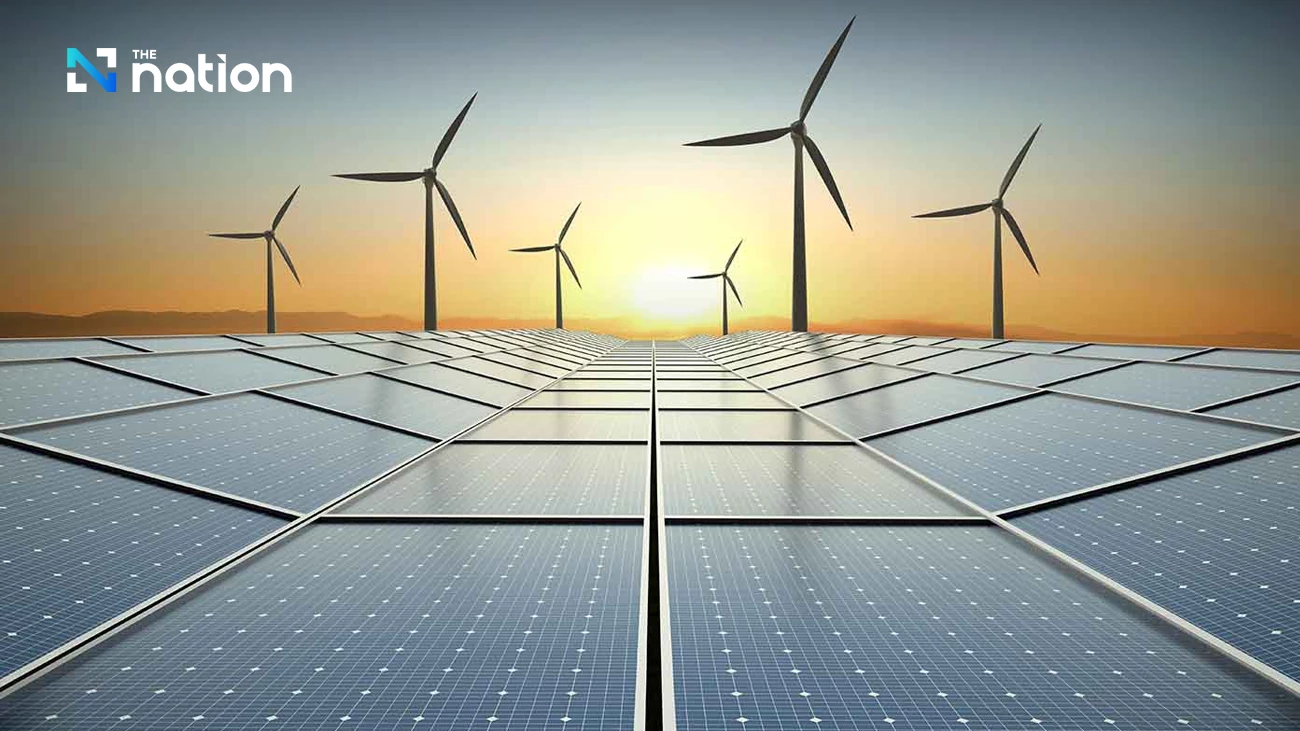
Thailand has a landscape abundant with solar energy while many regions are moderately blessed with potential for wind development. Its initiatives like ‘Solar for All’ and ‘Quick Big Win’ aim to reduce energy costs, stimulate investment, and cut CO₂.
According to Nation Thailand, the Quick Big Win initiative includes:
• 1,200+ solar-powered water-pumping systems covering ~700,000 rai of farmland.
• Target to reduce ~600,000 tonnes CO₂/year from this pump programme.
• Community Solar Farm Programme: 1,500 MW planned capacity.
• The PPA (power purchase rate) is up to THB 2.25/kWh for 25-year contracts per Thai Times.
• Estimated CO₂ reduction of 800,000 tonnes/year from the community solar farms.
• Tax incentive: up to THB 200,000 deduction per household for rooftop solar, this covers ~90,000 households, saving 585 million units of electricity and ~280,000 tonnes CO₂.
• Floating solar on dams (via EGAT) as part of this: Nation mentions 1,600 MW capacity tied to “Quick Big Win.”
• Emission reduction: the floating solar + dam plan will reduce “over 800,000 tonnes” CO₂ annually.
• 700 billion baht stimulus, 16,000 jobs, CO₂ reduction of over 10 million tonnes/year
The Hydro-Floating Solar Hybrid Projects (EGAT)
• The Electricity Generating Authority of Thailand (EGAT) has publicly documented its hydro-floating solar hybrid projects.
• EGAT’s Sustainability Report 2024 states:
o The Ubol Ratana Dam, Unit 1 hybrid project (24 MW) started commercial operation in March 2024.
o This floating-solar installation occupies less than 1% of the reservoir surface.
o The system integrates solar + hydropower + battery storage (BESS), to smooth generation.
o EGAT plans 16 such floating-hybrid projects across 9 dams, totaling 2,725 MW by 2030.
• On CO₂ savings: a Nation article reports that EGAT says its planned floating dam projects will reduce “more than 800,000 tonnes” of CO₂ annually.
• Also, EGAT’s 54th anniversary statement (May 2023) mentions its ambition: “the hybrid projects … up to 10,000 MW” potential in the long-run.
The Thailand Community Solar Farm Program
It aims to empower local communities by allowing them to host ground-mounted solar farms up to 10 MW each. The local communities give their consent to participation and private companies are selected to develop the solar farms. With a national capacity of 1.5 GW, it will involve the Provincial and Metropolitan Electricity Authorities buying electricity from these projects at a fixed feed-in-tariff rate of THB (Thai Baht) 2.25/kWh for 25 years. The program is part of the Ministry of Energy’s Quick Big Win initiative, a fast-track energy scheme first announced in October.
A key part of its broader renewable energy strategy to diversify the energy mix and reduce fossil fuel dependence, with targets of reaching 3,002 MW of wind capacity by 2036, Thailand’s Wind Energy Program entails the EGAT purchasing power from private producers through programs like the Small Power Producer (SPP) scheme.
Projects:
• The Theppana Wind Power Project – a private-sector utility-scale wind power project.
• Lam Ta Khong Wind Turbine Project – the first wind-hydrogen hybrid power generation system in Asia.
• Southern Thailand Wind Power and Battery Energy Storage Project – An ongoing project aimed at enhancing wind power generation and storage capacity in Southern Thailand, supported by the Asian Development Bank.
Conclusion
The government aimed to have 31% renewable energy by 2025 and install 3002 MW of wind power by 2036, involving community participation with supportive policies, Feed-in-Tariff Schemes and incentivization of the renewable projects for a sustainable and brighter future.
