

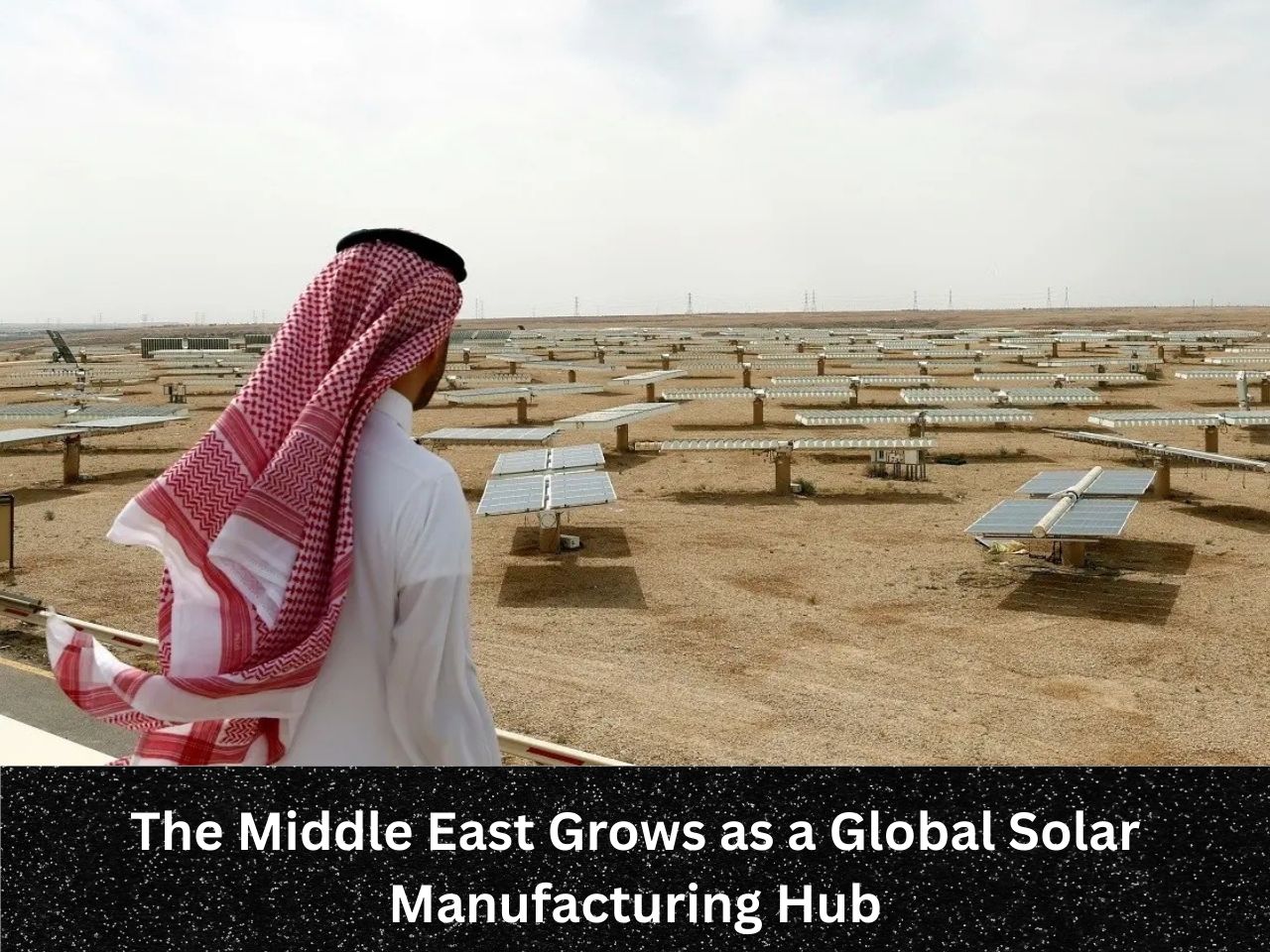
The Middle East region is at the heart of the energy world, technically and geographically. In fact, the energy sector is the backbone of the Middle East’s economy, powering industries, driving exports and fueling global innovation. With nations now moving away from fossil-fuel-based energy and the increasing demand for renewable energy generation, the Middle East region is also making notable progress in solar manufacturing.
The Middle East is on track to attract more than $100 billion annually in strategic capital expenditure, of which the energy sector, including the renewable segment, forms a major part, according to a comprehensive industry outlook by Grand View Research (GVR).
In this study, we look at the progress made by the countries in the region, specifically in the solar and solar-related manufacturing segment.
Need for Solar Manufacturing in the Middle East
The Middle East is pushing for renewable expansion, spearheaded by solar power. For this, the region is heavily dependent on imports of solar equipment. In addition, the favourable policies and geography are making the deepening of solar manufacturing an attractive option for the stakeholders.
According to a Wood Mackenzie report, module imports in the Middle East and North Africa (MENA) region doubled to 27 GW in 2024, driven by large-scale solar deployments in Saudi Arabia, the United Arab Emirates, and Oman.
In response to the surge in demand, the region is rapidly adopting a vertically integrated model for solar manufacturing, similar to China’s successful approach.
Middle East: The Rising Solar Manufacturer
The region is increasingly becoming a hotspot for solar manufacturing. One of the reasons is that the MENA region is emerging as a ‘tariff haven’ hub for solar manufacturing, benefiting from a comparatively low 10% basic tariff on modules imported into the United States. This gives MENA-based producers a competitive edge over other regional manufacturers facing duties of up to 651%, according to a Wood Mackenzie report from May 2025. Yet there’s more to it.
Economic diversification is another factor that is contributing to the growth of solar manufacturing in the region. With fluctuating oil prices in the era of energy transition, many countries are now looking to invest in renewables.
Governments across the MENA region, led by Saudi Arabia, the UAE, Oman, and Egypt, are actively inviting experienced global manufacturers to co-invest in local solar production. With strong public investment and attractive incentives, these partnerships are driving the development of integrated manufacturing hubs across the region.
Manufacturing Expansion: Spearheaded by Chinese Investment
Various countries are pushing up their solar manufacturing game, thanks to foreign investments, especially by Chinese players. Various enterprises are involved in the Middle East’s energy transition in various ways, such as exporting technology, investing in local manufacturing plants, and setting up regional headquarters.
More and more Chinese new energy companies are transforming from exporters to partners in the Middle East, as they start to set up factories and regional headquarters in the region. That means China has become an irreplaceable partner in the energy transition of the Middle East.
Even among the nations, few stand out.
Egypt
Egypt is accelerating its renewable energy transition through a combination of asset privatisation, large-scale foreign investment, and industrial localisation. The government has set a target for renewables: to account for 42 percent of electricity generation by 2030. This includes an annual domestic demand of 5-6 GW, and also export-oriented capacity and grid-scale energy storage.
The Egyptian Prime Minister Mostafa Madbouly recently opened the $116 million EliTe Solar industrial complex in the TEDA Egypt economic and trade cooperation zone. The zone is within the Suez Canal Economic Zone.
TEDA site is designed for a total solar manufacturing capacity of 5 GW – including 2 GW of solar cell production capacity and 3 GW of solar module manufacturing capacity.
Recently, Egypt has broken ground on an EGP 10.5 billion ($210 million) Atum Solar integrated manufacturing complex in Sokhna in the Suez Canal Economic Zone (SCZONE) in Egypt. It will comprise three facilities and is targeting an annual manufacturing capacity of 2 GW of solar cells and 2 GW of solar modules. The solar cells manufacturing will be 100% for export, while the 2 GW of solar panels and 1 GWh of energy storage systems capacity will target local and regional markets, according to the SCZONE.
China is now heavily invested in Egypt. The China Energy Engineering Corporation (CEEC) is deepening its presence in the country with a planned $1 billion investment over the next five years, targeting renewable power generation, energy storage, and water desalination.
Chinese firm Sunrev Solar has also commenced construction of an integrated solar energy components industrial complex in Egypt, with the first phase comprising two factories producing 2 GW of solar cells and modules.
Saudi Arabia
Saudi Arabia is another country pushing hard for solar manufacturing initiatives. Saudi Authority for Industrial Cities and Technology Zones has signed a contract with Desert Technologies to establish an industrial complex backed by $199 million investment, and will produce solar panels and cells with an annual capacity of up to 5 GW.
NextPower has been expanding in the region for the solar tracker business, with the company’s Saudi joint venture, NextPower Arabia, building a manufacturing facility in the country. The facility is set to have an annual supply chain of up to 12GW of solar tracking systems. In the solar tracker segment, other major players exploring the region for its renewable potential in this segment include GameChange Solar, TrinaTracker, and PV Hardware.
SoleFiori, a China-based solar module manufacturer, is setting up 6 GW of HJT facility in Saudi Arabia.
Another major Chinese firm, Trina Solar, has built a factory in Saudi Arabia that began operations in the first quarter of 2025. Ni Lili, president of the solar production division of Trina Solar, said that the company views the Middle East as a frontier base, because the market is highly attractive, combining prime solar resources with significant financial backing.
In 2024, TCL Zhonghuan Renewable Energy signed an agreement with Saudi Arabia’s Public Investment Fund (PIF) and Vision Industries to begin producing 20 GW of solar ingots and wafers per year in the country.
UAE
In Dubai, companies like DuSol Industries and Almaden Solar continue production and are expanding to incorporate N-type cell technologies.
The Singapore-based Gstar plans to build a 2 GW module facility in the UAE for N-type modules. In May, Japan-based Nippon Energy announced plans to launch a 1 GW module manufacturing facility in Dubai.
Oman
Oman is an emerging market, with Sheida Industries launching Oman’s first solar panel manufacturing facility in the Sohar Industrial Area. Oman Arab Bank has announced a landmark $220 million investment in a new polysilicon factory.
The facility is designed to produce enough polysilicon to contribute to the manufacturing of 40 GW of solar modules annually. Beyond Oman Arab Bank, other major investors include the International Finance Corporation (IFC) with a loan of up to $250 million and the Future Fund Oman, contributing $156 million.
Challenges Ahead
A major hurdle for the solar manufacturing expansion in the Middle East is the heavy reliance on imported raw materials and components, especially from Asia, making supply vulnerable to global disruptions.
Shortage of technical expertise and skilled labour is also a crucial bottleneck which needs to be solved to meet international standards for solar component manufacturing.
Moreover, financing is a challenge as the solar manufacturing expansion demands substantial upfront investment, with challenges from established global players making it difficult for the regional ventures to gain market traction.
As the fossil fuel-based energy demand and stock fade, the countries are keen on advancing the new energy industry.
